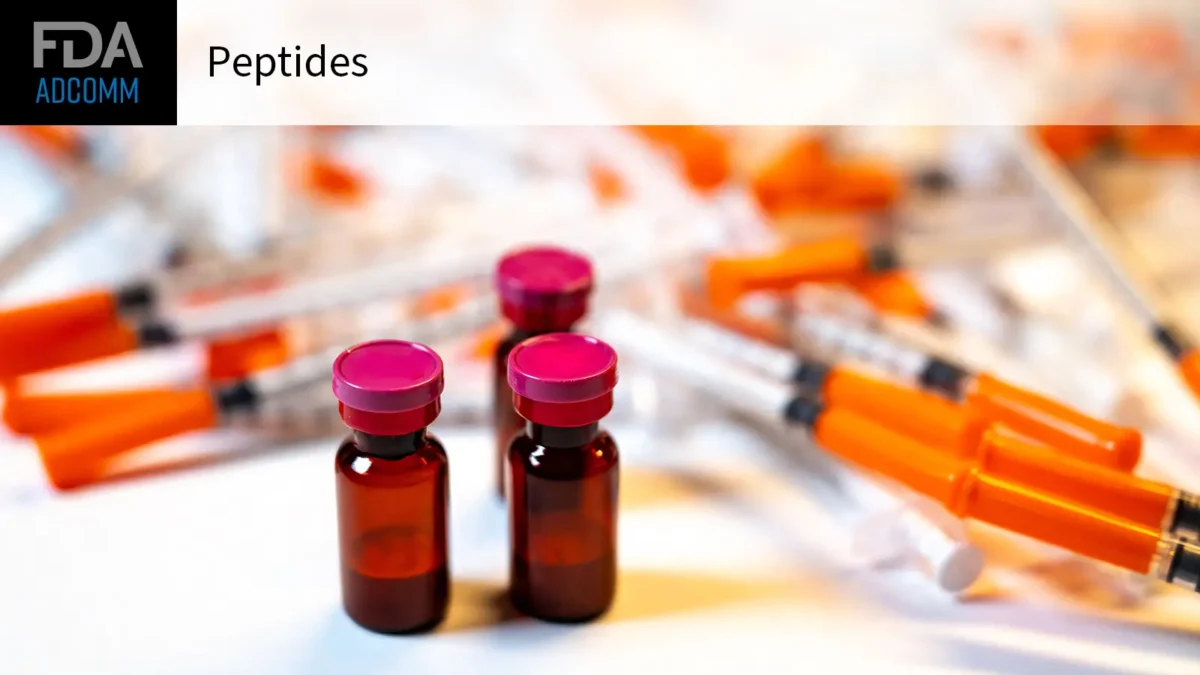
The headlines suggested otherwise, but the FDA advisers did not exactly endorse BPC-157 and a few other popular peptides. At best, the vote in July 2026 opened the door for compounded preparations of six substances, not that it legitimizes them as thoroughly tested, medically beneficial products.
It is important to understand what the recommendation really means and what it does not.
What peptides did the committee support for compounding?
The advisory committee debated seven substances during its July 23-24 meeting:
- BPC-157
- KPV
- TB-500
- MOTS-c
- Semax
- Epitalon
- Emideltide, also known as DSIP
FDA advisers recommended the first six for inclusion in the 503A Bulks List whereas Emideltide was the only one rejected. Most votes were not overwhelming: BPC-157, KPV and TB-500 each got eight votes in favor, six against and one abstention; MOTS-c – seven for, five against, and two abstentions; Semax and Epitalon were approved the next day.
The narrow margins reflect the division within the committee. Advocates for the peptides pointed out that many people already buy these substances from disreputable online pharmacies. Letting licensed facilities prepare them for specific patients would be a safer alternative to the status quo. Others were concerned that the recommendation is premature – these are mostly peptides with limited evidence in terms of human trials, dosing regimens, and long-term risks.
FDA staff had warned that none of the seven should be added to the 503A Bulks List. In their comments on each substance, reviewers consistently raised concerns about insufficient data on efficacy, indications, dosing, and product quality. The advisory committee still decided to override their caution for six of them.
What is the 503A Bulks List?
Section 503A of the Federal Food, Drug and Cosmetic Act governs the traditional compounding process. Basically, it allows state-licensed pharmacies and, in some cases, physicians, to prepare medications for a particular patient instead of using an FDA-approved drug. Those compounded products contain the same active ingredients but usually in different forms and doses. A pharmacist can also alter the formulation to avoid an allergen or an inactive substance that is not available in commercial preparations.
Pharmacies typically compound medications from FDA-approved drug products or substances included in the 503A Bulks List. The latter is a list of ingredients that can be used in a compounded drug product even though they are not approved for the specified indication. Therefore, adding a substance to this list would allow a licensed pharmacy to compound it upon a valid prescription.
It does not mean that the FDA approved this product for a specific use. Compounded drugs are exempt from the premarket review process that applies to all FDA-regulated medications. Our guide to FDA-approved and compounded drugs explains the differences in more detail.
Does this vote make these peptides legal to compound?
Not precisely.
The advisory committee’s vote is only a recommendation. The FDA is free to accept or reject it when determining whether a substance should be included in the 503A Bulks List. Either way, the agency would need to take additional steps before any of these six peptides could be officially approved for compounding. In fact, as of August 2026, this process has not been completed. The July vote, then, does not automatically authorize all compounding pharmacies to start preparing these substances for patient use.
In the same vein, the vote does not legalize the sale of these peptides as “research chemicals.” A “not for human consumption” warning on the bottle does not make this product safe, effective or legally recognized as a drug.
What are these peptides supposed to do?
The uses of BPC-157 and TB-500 are well known – these are two of the most popular peptides for cutting and for promoting recovery and healing in the athlete community. The two are sometimes combined in a supplement called “Wolverine Stack.” KPV is indicated for inflammatory and digestive tract conditions, MOTS-c is used to support metabolism, exercise and weight. Semax is a cognition-enhancing drug similar to Adderall but with less risk of abuse; Epitalon is heavily marketed in the anti-aging space.
The applications for these peptides are much broader than what the advisory committee discussed. When reviewing BPC-157, for example, the reviewers focused on the healing properties in patients with ulcerative colitis rather than on athletic injuries. Similarly, the discussion around MOTS-c centered on obesity and osteoporosis whereas TB-500 was examined in the context of wound healing. A recommendation for one application does not necessarily apply to all the uses mentioned on a clinic’s website. Notably, none of these six peptides has undergone the full FDA review process, which means that the human data are mostly anecdotal or based on animal studies.
Why did the advisers vote yes if there is not enough evidence?
The committee members disagreed on what the vote really means. Some reviewers felt that the recommendation would help meet the demand for these substances. A significant number of patients already purchase these peptides from unregulated online sources. Having these preparations made in a compounding pharmacy would be much safer than injecting an unknown solution purchased on the dark web.
Others, however, argued that the vote ignores the clinical evidence. It is one matter to support the right to obtain these potentially harmful substances and quite another to prove that they are actually beneficial. If the medical community does not have enough information on the long-term risks, the best way to ensure patient safety is to keep them out of the hands of profiteers and restrict their availability to research facilities.
Should patients trust these compounded medications?
The vote does not make these substances safe or effective, but it does offer hope that some day they may become available through a reliable source. At the same time, the July 2026 vote certainly does not endorse them as fully proven treatments.
It should not mislead patients into thinking that the FDA approved BPC-157 or any other peptide for healing, weight loss or muscle building. There is no such indication for any of these substances. This vote does not establish the appropriate dose, identify the target population or collect the necessary safety data. It does not replace the clinical trials that all drugs must undergo before they can be prescribed with any degree of certainty. Moreover, even if a compounded preparation is ready now, this does not guarantee that it will be covered by insurance.
This recommendation also does not apply to the established class of FDA-approved peptide drugs. Yes, insulin, GLP-1 and many other medications are also peptides, but they have gone through a complete development cycle including extensive trials in humans. The fact that a substance has this particular class of drugs does not make it any safer or more effective.
What should patients ask next?
I recommend that patients be wary of any clinic that claims to have these FDA-approved substances. Such wording is misleading at best – these preparations are not approved by the FDA. Patients should inquire as to what evidence supports the use of this particular preparation, whether there have been human trials and what the known side effects are. It may also be worth investigating who manufactures this product and whether the compounding pharmacy receives such products regularly. The prescribing physician should be able to answer these questions as well as provide specific information on monitoring the therapeutic response and managing potential adverse effects.
The vote in July 2026 is significant in that it may finally bring some order to the chaotic market of peptides. It remains to be seen whether this will contribute to patient safety or simply increase the accessibility of these inadequately studied products.