
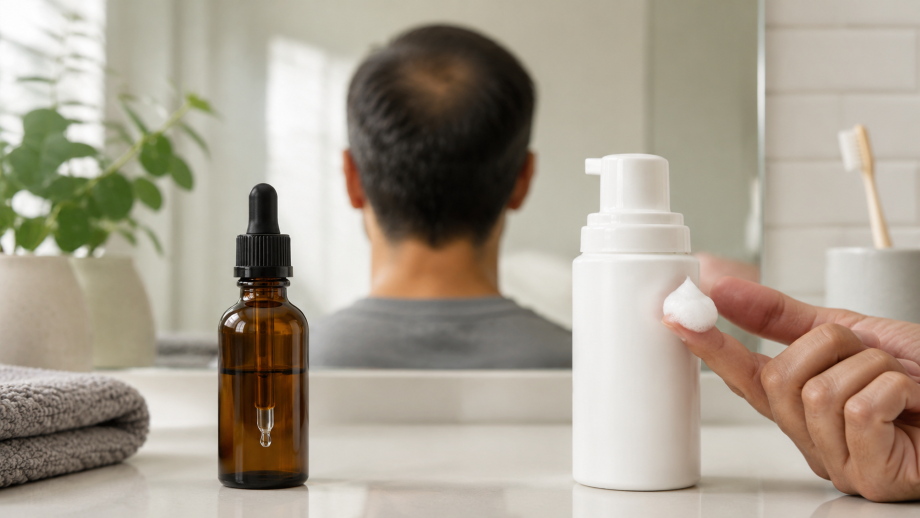
At first glance, it seems like a toss-up. One has a dropper; the other leaves the can as a puff of foam. Both contain minoxidil, so what difference could it make?
Quite a big one when you have to use one daily.
Liquid minoxidil is often cheaper and easier to measure out, while foam dries more quickly and is less greasy. For hair growth, there is no evidence that either is universally better — simply go with what you can tolerate and will continue to use after six months.
Do liquid and foam minoxidil work the same way?
Both get minoxidil to the scalp, where the medication acts by keeping susceptible hairs in their growing phase for a longer period and possibly enlarging the hair follicles that have shriveled.
This makes topical minoxidil a suitable treatment for androgenetic alopecia (otherwise known as male or female-patterned baldness), but not a panacea for all types of thinning. A fungal infection, severe iron deficiency, scarring alopecia, or patchy alopecia areata need something else. Minoxidil also demands patience: A person may notice initial improvements after two to four months, but judging the results may take up to six months or more. Our guide to how long it takes minoxidil to work talks a little about this.
Why does liquid minoxidil irritate?
Standard liquid minoxidil contains alcohol, water, and propylene glycol. This last ingredient helps to dissolve minoxidil and get it to the skin — with some people, it provokes an itchy, red, flaky, or sore scalp.
The liquid can also run down the forehead when applied in excess and, when dry, leave the hair feeling stiff or greasy. Where the person has long hair, a substantial proportion of the dose can be distributed throughout the hair rather than on the scalp.
It is not all doom and gloom about the dropper bottle. Liquid minoxidil allows you to deliver tiny amounts down a part in your hair or straight to the crown of the head. It is widely available in generic form and is often the cheaper option.
For someone with short hair and no sensitivity to propylene glycol, ordinary liquid minoxidil may well be just the ticket.
What makes the foam so liveable with?
Minoxidil foam does not normally contain propylene glycol, which removes a possible cause of irritation, and explains why dermatologists may recommend the foam if liquid minoxidil provokes persistent itching or dandruff-like flakiness.
It also dries more quickly and leaves less residue, so you are less likely to turn up at work with your roots damp.
There is a technique to applying the foam, as it melts away almost on warm fingers immediately after dispensing. Applying to cool, dry fingers (or sometimes on a cool dish) can be more convenient. Part the hair and press the foam into the exposed scalp rather than spreading it over the hair.
Foam may be unwieldy if the person has thick, long hair. It can disappear into the hairstyle and be less accurate in measuring the dose than drawing up to the 1-mL mark on the dropper.
Is foam better than liquid?
The studies do not provide a clear answer.
In one trial, once-daily 5% foam and twice-daily 2% solution were compared in women. The hair-growth outcomes were similar after 24 weeks, but foam caused less local irritation and interfered less with hairstyling.
As the trial did not compare the same concentrations of solution and foam, the conclusion is that 5% foam and 5% liquid are not necessarily the same — but foam can achieve comparable results without the propylene glycol.
Real life brings in the variable of convenience. A theoretically optimal treatment is rendered fairly useless if the person stops using it four nights a week because it made their scalp greasy — convenience is part of the effectiveness.
Which should you go with?
Liquid minoxidil may be better if:
- Price is a concern
- You want the precision of a dropper
- You have short or partable hair
- Propylene glycol does not irritate your scalp
Foam may be preferable if:
- Liquid minoxidil provokes itching, soreness, or flakiness
- You want no greasy residue
- You need something which will dry quickly
- A hassle-free morning helps you to stick with it
Check the instructions for the exact product you buy. Application schedules can vary depending upon the concentration, the formulation (liquid or foam), and whether the product is for men or women. Extra doses will not make your hair grow faster.
What can you expect?
Some hairs may shed in the first few weeks as the follicles work through their growth cycle. This can be alarming, especially if one was using minoxidil as a means to prevent further loss, but it usually resolves.
Scalp irritation and unwanted facial hair may also happen. Let minoxidil dry before going to bed, wash your hands after applying, and keep the medication away from the forehead. Refer to our guide to common minoxidil side effects for more information about these symptoms.
Chest pain, faintness, a racing heart, swollen hands or feet, or sudden weight gain are not normal side effects. Discontinue the product and seek medical advice.
Keep minoxidil products away from children and pets. Ingestion can be dangerous, and the medication is particularly toxic to cats and dogs.
Foam wins comfort for many, but liquid wins on price and precision. Neither can make up for a wrong diagnosis or a routine used for only three weeks. Make sure the pattern of thinning is something which minoxidil can actually treat before choosing anything.