Categories
Blog/Everyday Health

What Is mFlusiva? The First mRNA Flu Vaccine

mFlusiva could become the first seasonal mRNA flu vaccine approved in the United States. Here is how it works, what its trial found, and how it compares with existing flu shots.

Flu vaccines have been around for decades, so another one would not normally attract this much attention. mFlusiva is different. Instead of being made with eggs, cultured cells, or purified influenza proteins, it uses messenger RNA—the same basic vaccine technology that became widely known during the COVID-19 pandemic.

Moderna developed mFlusiva specifically for seasonal influenza. The company is asking the FDA to authorize it for adults aged 50 and older, the group more likely to become seriously ill when flu season turns rough.

As of August 5, 2026, the FDA’s final decision had not yet been publicly announced. An independent advisory committee has already voted unanimously that the vaccine’s benefits outweigh its risks, but that vote is a recommendation rather than an approval. Until the FDA completes its review, mFlusiva remains an investigational vaccine in the United States.

If it receives approval, it will become the first seasonal mRNA flu vaccine licensed in the country. That would be a genuine first. Still, it does not mean that every older adult should immediately replace the flu vaccine they usually receive. The trial results are promising, but there are questions—particularly for people over 65—that will continue to be studied.

What exactly is mFlusiva?

mFlusiva is Moderna’s proposed brand name for mRNA-1010, a seasonal influenza vaccine delivered as an injection into the muscle.

The current version is designed to protect against three influenza strains: two influenza A strains and one influenza B strain. These are selected to represent the viruses experts expect to circulate during the coming flu season.

The vaccine does not contain a live influenza virus. It cannot reproduce in the body, and it cannot give someone the flu.

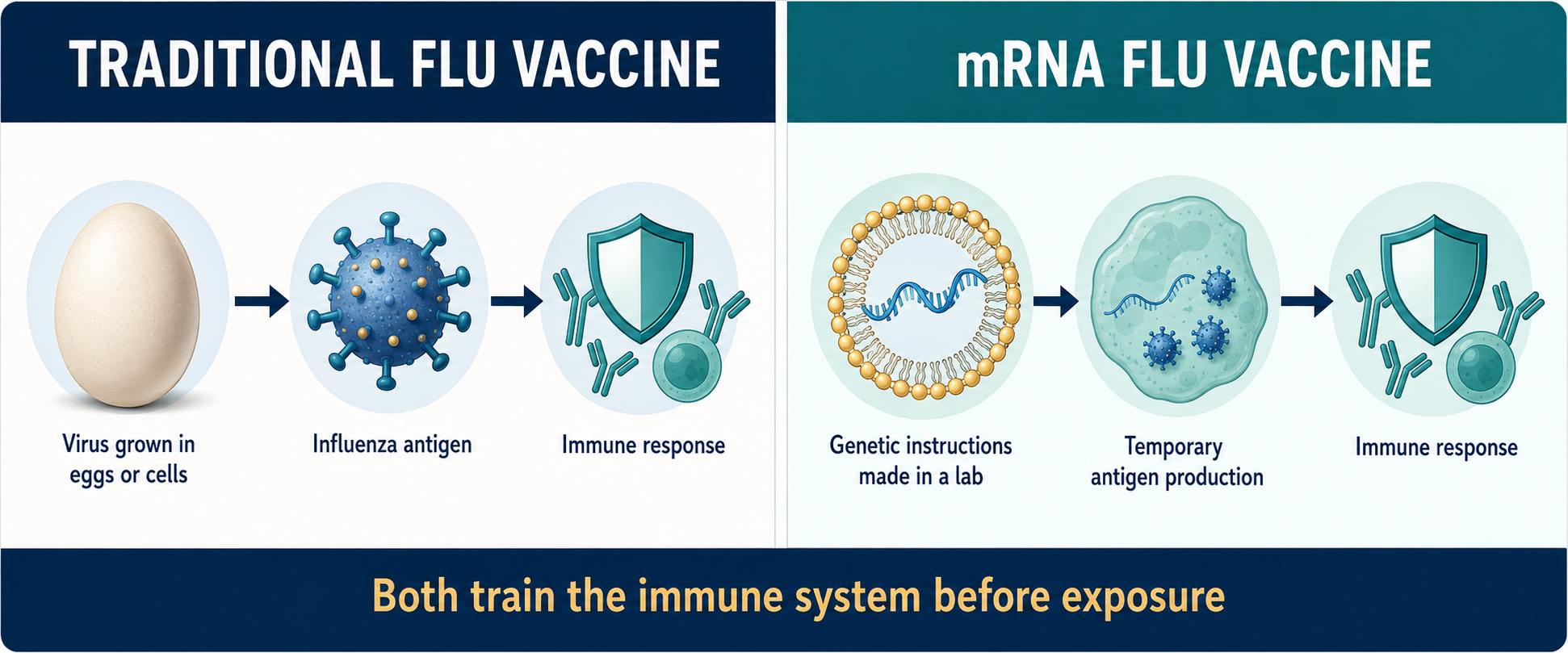
Instead, each dose contains strands of messenger RNA wrapped inside tiny fat particles known as lipid nanoparticles. The mRNA carries instructions that briefly tell cells to make copies of hemagglutinin, a protein found on the surface of the influenza virus.

The immune system recognizes that protein as foreign and begins building antibodies and other immune defenses against it. Later, if the vaccinated person encounters the actual virus, the immune system has a better chance of responding before the infection becomes severe.

Once the instructions have been delivered, the mRNA is broken down. It does not enter the nucleus of the cell, where DNA is stored, and it does not change a person’s genes.

That last point became one of the most persistent misunderstandings surrounding COVID-19 vaccines. mRNA is better thought of as a temporary message, not a permanent edit to the body.

How is a regular flu vaccine made?

“Regular flu shot” can mean several different things.

Many traditional influenza vaccines are grown in fertilized chicken eggs. The selected viruses are injected into eggs, allowed to multiply, harvested, purified, and then processed so they can be used safely in a vaccine.

This approach has a long safety record. It is also slow. Manufacturers need enormous numbers of suitable eggs, and production has to begin months before flu season arrives.

Growing the virus in eggs can occasionally introduce small changes called egg-adaptive mutations. The virus becomes better suited to growing in eggs but may become slightly different from the strain circulating among people. That can affect how closely the vaccine matches the virus encountered during flu season.

Some newer vaccines avoid eggs. Cell-based vaccines grow influenza viruses in mammalian cells, while recombinant vaccines use engineered cells to produce influenza proteins without growing the whole virus.

There are also high-dose and adjuvanted flu vaccines intended to produce a stronger immune response in older adults. FluMist, meanwhile, is a nasal-spray vaccine containing weakened live viruses and is approved only for certain people between the ages of 2 and 49.

So the choice has never been quite as simple as “mRNA versus a regular shot.” Several conventional options already exist, and they are not identical.

What makes mFlusiva different?

The biggest difference is the manufacturing process.

Scientists do not need to grow large quantities of influenza virus in eggs or cells. Once they know which viral proteins the vaccine should target, they can produce the corresponding mRNA sequence.

That may allow manufacturers to respond more quickly when public-health agencies select the strains for the upcoming flu season. A shorter production timetable could give scientists more time to see which strains are actually circulating before the final vaccine is made.

Flu is difficult to predict. Global experts recommend vaccine strains months in advance because traditional manufacturing takes so long. Sometimes the prediction is good. In other years, the virus changes or an unexpected strain becomes dominant.

mRNA technology does not remove that uncertainty. A vaccine still needs to target the right strains, and production cannot be changed at the last minute without regulatory and manufacturing work. It may, however, make future updates faster and more flexible.

Another possible advantage is avoiding egg-adaptive changes. Since mFlusiva is not grown in eggs, the vaccine’s targeted protein can more closely reflect the original selected influenza strain.

Those advantages sound attractive on paper. What matters to patients is whether they produce fewer flu cases, hospital visits, and deaths. That is why the clinical trial is more important than the novelty of the technology.

How effective was mFlusiva in the trial?

Moderna’s main Phase 3 study included nearly 41,000 adults aged 50 and older across North America, Europe, and East Asia. Participants received either mFlusiva or an existing licensed flu vaccine.

mFlusiva demonstrated a relative vaccine efficacy of 26.6% against laboratory-confirmed influenza-like illness compared with the standard-dose vaccine used in the trial.

That number is easy to misunderstand.

It does not mean the mRNA vaccine prevented only 26.6% of flu cases. It also does not mean that 26.6% of everyone who received the conventional vaccine became sick.

Relative vaccine efficacy compares the two vaccinated groups. In this case, people who received mFlusiva experienced about 26.6% fewer confirmed influenza cases than those who received the comparator vaccine.

A simple fictional example helps. Imagine that 100 people became ill in the conventional-vaccine group. A 26.6% relative improvement would correspond to roughly 73 or 74 cases in a similarly sized mFlusiva group. The real study used much larger numbers and formal statistical analysis, but that is the basic idea.

The study also suggested fewer higher-level healthcare encounters, such as emergency or urgent-care visits, among mFlusiva recipients. Those findings were encouraging, although the trial covered only one flu season.

The FDA’s advisory committee found the evidence convincing enough to vote 9–0 that the vaccine’s benefits outweighed its risks for adults aged 50 to 64. The committee held a separate vote for adults 65 and older and again voted 9–0 in favor. The FDA’s mFlusiva review documents provide the full regulatory analysis.

Why was the over-65 group more complicated?

Adults over 65 account for a large share of serious flu complications, hospitalizations, and deaths. Unfortunately, their immune systems do not always respond as strongly to vaccination.

For that reason, the CDC has generally preferred high-dose, recombinant, or adjuvanted flu vaccines for this age group when they are available.

Moderna’s efficacy trial compared mFlusiva mainly with a standard-dose vaccine. FDA reviewers questioned whether that was the right comparison for older adults who would ordinarily be offered a stronger vaccine.

Moderna provided another study comparing immune responses with a high-dose flu vaccine. Based on those antibody results, the company requested an accelerated-approval pathway for people aged 65 and older.

Accelerated approval would not mean that the evidence was ignored. It would mean the FDA accepted an immune-response marker as reasonably likely to predict clinical benefit while requiring Moderna to confirm that benefit through a larger post-approval study.

The proposed follow-up study is expected to include hundreds of thousands of older adults across two flu seasons. Its purpose would be to compare real-world outcomes with a flu vaccine already preferred for seniors.

That is a fairly important detail for someone deciding which vaccine to receive. An advisory committee believed mFlusiva’s benefit-risk balance was favorable for older adults, but the most direct comparison with preferred senior vaccines is not yet complete.

Does mFlusiva cause more side effects?

mFlusiva produced more short-term reactions than the conventional vaccines used as comparators.

The most common complaints were pain at the injection site, fatigue, headache, muscle aches, and chills. Most were mild or moderate and lasted about two days.

For some people, that may mean planning a quieter evening after the injection. It does not mean the vaccine caused influenza. The aches and fatigue come from the immune response, not from infection with a live flu virus.

Serious adverse events occurred at similar rates between the mFlusiva and comparator groups. Deaths from all causes were also balanced between groups during follow-up.

FDA reviewers examined a numerical imbalance in deaths recorded without a clearly specified cause. After reviewing the timing and participants’ medical histories, the agency concluded that it was unlikely to represent a vaccine safety signal. Many of the individuals involved had significant cardiovascular or metabolic disease, and there was no clear pattern suggesting the vaccine was responsible.

The available safety data are reasonably reassuring, but no trial can detect every extremely rare reaction. If approved, mFlusiva would continue to be monitored as use expands.

There are also groups for whom the evidence is thinner, including very frail older adults and some immunocompromised patients. Those gaps are one reason post-approval surveillance and additional studies matter.

Can an mRNA flu vaccine give you the flu?

No. mFlusiva contains no live influenza virus.

The vaccine provides temporary instructions for producing a viral protein that the immune system can recognize. It does not create a complete influenza virus capable of infecting the body.

Someone may develop a headache, chills, muscle aches, or fatigue after vaccination. Those symptoms can resemble the beginning of the flu, but they usually reflect immune activation and settle within a few days.

It is also possible to catch a respiratory infection shortly after receiving any flu vaccine. Protection takes time to develop, and the vaccine does not prevent common colds, RSV, COVID-19, or every influenza infection.

People sometimes say, “I got the shot and then I got the flu.” What they experienced may have been a different virus, an infection acquired before immunity developed, or a flu strain not well matched by the vaccine.

Is mFlusiva the same as a COVID-19 vaccine?

No, although the underlying delivery technology is related.

COVID-19 mRNA vaccines teach the immune system to recognize a protein from SARS-CoV-2. mFlusiva uses mRNA sequences that correspond to proteins from selected influenza strains.

The target is different, the dose is different, and the vaccine formulation and clinical evidence are evaluated separately.

Previous experience with COVID-19 vaccines helped researchers learn how to manufacture and monitor mRNA products at enormous scale. It does not allow a new flu vaccine to skip clinical trials or FDA review.

Each vaccine still has to demonstrate that its own benefits outweigh its own risks.

Would mFlusiva replace regular flu shots?

Not immediately, and perhaps not completely.

Even if approved, mFlusiva would initially be one option for adults 50 and older. Conventional egg-based, cell-based, recombinant, high-dose, and adjuvanted vaccines would continue to exist.

Pharmacies may not receive the new vaccine right away. Manufacturers and pharmacy chains plan flu-vaccine purchases well in advance, and Moderna reportedly missed part of the contracting window for the 2026–2027 season.

An FDA approval and widespread pharmacy availability are not always the same event. Distribution, CDC recommendations, insurance coverage, supply contracts, and local inventory all influence when a patient can actually receive a product.

Cost will matter as well. Most insured patients receive recommended seasonal flu vaccination without a separate charge, but coverage rules depend on the final approval and vaccination recommendations. Anyone specifically requesting mFlusiva would need to check whether the pharmacy stocks it and whether the health plan covers it.

A trusted online pharmacy can help patients understand prescription treatments and medication access, but vaccines must be administered through an appropriately authorized vaccination service.

How does vaccination differ from antiviral treatment?

A vaccine is used before exposure to reduce the likelihood or severity of influenza. Antiviral medications are used after infection or, in certain situations, after a significant exposure.

Oseltamivir, better known as Tamiflu, is one example. It interferes with the influenza virus’s ability to spread from infected cells. It tends to work best when started within 48 hours of symptom onset, particularly for people at higher risk of complications.

Vaccination and antivirals are not competing strategies. A vaccinated person can still develop influenza and may still need treatment. Likewise, keeping an antiviral prescription in the medicine cabinet does not provide the season-long protection expected from vaccination.

Our guide to antiviral medications explains how these drugs differ from antibiotics and why timing matters. Patients looking for information about prescription antiviral treatments should speak with a healthcare professional rather than treating every fever or cough as influenza.

Antibiotics do not treat flu. They are useful only when a bacterial complication is diagnosed or strongly suspected.

If it is approved, should you choose mFlusiva?

That decision will depend on age, medical history, vaccine availability, and the final recommendations from the FDA and CDC.

For an adult aged 50 to 64, mFlusiva may become an appealing option because it performed better than a standard-dose conventional vaccine in the Phase 3 study.

For someone aged 65 or older, the choice may require a little more discussion. High-dose, recombinant, and adjuvanted flu vaccines already have established roles in this age group. mFlusiva produced strong immune responses, but the large clinical comparison with a preferred senior vaccine is still planned.

Waiting indefinitely for one particular product is not always sensible. Flu-vaccine protection takes time to develop, and delaying vaccination can leave someone unprotected while influenza is already spreading.

The best flu vaccine is often an appropriate one that is available at the right time.

Anyone with a history of a serious allergic reaction to a vaccine, Guillain-Barré syndrome after a previous flu vaccination, significant immune suppression, or another complicated medical history should discuss vaccine choice with a clinician or pharmacist.

Pregnant patients should follow current recommendations for vaccines specifically authorized and recommended during pregnancy. mFlusiva’s place in pregnancy cannot be assumed until regulators review the data and issue formal guidance.

What mFlusiva could change beyond one flu season

The most interesting part of mFlusiva may not be whether it becomes the preferred vaccine this year.

Seasonal flu requires manufacturers to predict which strains will matter months before people begin getting sick. A production method that can move faster could shorten that gap. It may also help public-health agencies respond when a flu strain changes unexpectedly.

The same platform could eventually be used for combined vaccines. Moderna has already been developing a single injection intended to protect against both influenza and COVID-19.

That does not guarantee that every future mRNA vaccine will work. Technology is not evidence by itself. Each product must still prove that it prevents meaningful illness without introducing unacceptable risk.

For now, mFlusiva has done enough to earn unanimous support from the FDA’s independent advisers. Its trial results suggest that it can prevent more confirmed flu cases than the standard-dose vaccine used in the study, although it also causes more brief reactions such as injection-site pain and fatigue.

If the FDA approves it, the United States will gain another flu-vaccine option—not a replacement for every existing shot and not a perfect shield against influenza.

That may sound less dramatic than “the first mRNA flu vaccine.” It is also closer to what patients are likely to encounter at the pharmacy: another choice, some promising data, and a conversation about which vaccine makes the most sense for them.

By Dr. David Kahan, PhD

  • Education: – B.S. in Kinesiology, 1990, UCLAM. Ed. in Teacher Education, 1991, UCLA Ph.D. in HPER, 1995, The Ohio State University
  • Professional Memberships: American Alliance for Health, Physical Education, Recreation & Dance (AAHPERD), National Association for Kinesiology and Physical Education in Higher Education (NAKPEHE)
  • Research Areas: My initial focus in graduate school was directed at coaching behavior with special emphasis on gender dynamics (e.g., males coaching female athletes). At my first appointment, I changed my focus to better match a major job responsibility—the preparation and supervision of preservice (student teachers and undergraduate field practicum students) teachers. To this end, I spent 5 years on projects to better understand cooperating teacher behavior and beliefs. Beginning in the Fall of 2001, I again switched my focus to issues involving the relationship between physical activity and religion/culture. During a sabbatical year in 2009, I added focus by investigating the impact of social-ecological variables on preschool children’s physical activity.