
Moderna launches flu vaccine made of Mrna, called mFlusiva
mRNA vaccines have had their debut during the COVID pandemic. Their novelty has been used in a flu vaccine.
In August 2026, the FDA approved Moderna’s new influenza vaccine for use in adults 50 years and older. mFlusiva is the first seasonal influenza vaccine in the United States not made in eggs or with cultured influenza virus.
The arrival of mFlusiva is an important step, but is unlikely to end the reign of any particular influenza brand. Moreover, the vaccine received approval for use among people who are 50 years of age or older.
How does mFlusiva work?
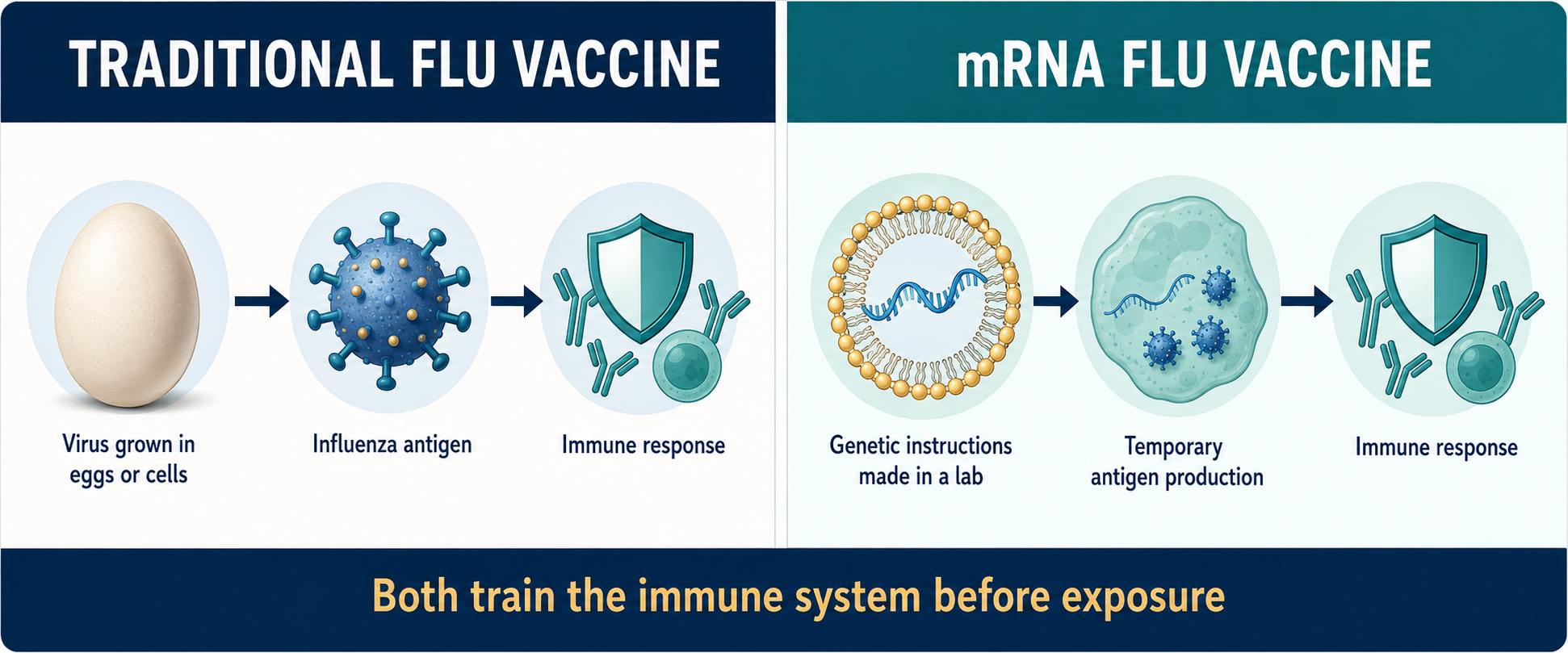
The traditional influenza vaccines are based on proteins from the virus, while mFlusiva instructs antigen-specific T.Helper cells to produce copies of the hemagglutinin protein.
Like other RNA vaccines, mFlusiva’s messenger RNA molecules are delivered to the recipient’s cells, where they encode the instructions for copying viral proteins. The cell machinery reads these instructions and makes copies of the protein, which are detected by the immune system as foreign. The immune system then produces antibodies directed against these proteins. The instructions encoded in mRNA disappear when the cells have finished making the protein copies. Consequently, the protein copies are broken down by the body. Since neither mRNA nor protein enters, the nucleus of the cell does not change, and the genetic information is not altered.
Notably, mFlusiva does not contain any virus proteins so it cannot infect people. As is customary for influenza vaccines, mFlusiva contains three viral antigens (influenza A/H1N1, influenza A/H3N2, and influenza B/Victoria) selected for the current season.
How effective was the vaccine?
Overall, in a Phase III trial of more than 40,000 people, mFlusiva was found to be 26.6% more effective than a standard-dose comparator vaccine against influenza that was actually confirmed in the laboratory. The relative effectiveness of a vaccine is not an intuitive measure because it is calculated as the ratio of risk between two groups. In this case, this means that the risk of getting the flu was reduced by 26.6% in the vaccinated group compared to the unvaccinated group.
At the same time, it would be incorrect to interpret the results of the study as stating that the vaccine neutralized 26.6% of possible cases of the disease. It was the best performance against a particular influenza virus for those aged 50 to 64 years, compared to standard vaccines (about 8% in the vaccinated group versus 12% in the unvaccinated). For people aged 65 years and older, trials of mFlusiva were compared to a high-dose vaccine in terms of immunogenicity. According to the results, mFlusiva demonstrated performance similar to that of a high-dose vaccine against each of the three strains.
What stopped older people from getting mFlusiva?
In contrast to those aged 50-64, for whom Flucelis received standard FDA approval, Flucelis for those over 65 was granted accelerated approval based on surrogate markers. This means that further trials in this population are needed to confirm the results.
However, the accelerated approval is still a valid FDA approval. It provides companies with the opportunity to market the product earlier, but with the condition that the pharmaceutical company conducts additional research confirming the benefit of the drug. In this case, the surrogate endpoint is the immunogenicity, which has already shown good results.
Is it better than a regular flu shot?
It all depends on the vaccine and the vaccinated person. Adults over 65 years of age usually get high-dose or adjuvanted vaccines while those aged 50-64 get standard-dose ones. The trial compared mFlusiva to a standard-dose comparator vaccine, and not to a high-dose one.
However, some older people find regular shots ineffective. They then turn to high-dose options, such as Fluzone High-Dose Quadrivalent or Flucelis. The choice of vaccine then depends on a person’s age, weight, allergies, and doctor’s recommendations.
The ability to use mRNA technology is a huge advantage because it allows for easy customization of the vaccine. It remains to be seen whether it will really be possible to individualize the vaccine for each patient, as often claimed. But this technology does open up great opportunities for responding to seasonal influenza and pandemics.
What are the side effects?
The most common side effect of mFlusiva was injection-site pain. Other common side effects included fatigue, headache, myalgia, arthralgia, and axillary lymphadenopathy. In most cases, discomfort was mild or moderate and lasted about two days. Sudden fainting spells or more severe allergic reactions are also possible. People who develop Guillain-Barre syndrome within six weeks of receiving a flu vaccine should consult their doctor before getting mFlusiva.
Who can get mFlusiva?
mFlusiva is indicated for vaccination against influenza in adults 50 years of age and older. Each dose of mFlusiva is administered as a single intramuscular injection of 0.38 mL.
mFlusiva should not be administered to patients who have previously received a dose of mFlusiva or who have a known hypersensitivity to any component of the vaccine.
No vaccine is completely effective, and protection may be reduced in immunocompromised people. As with other influenza vaccines, mFlusiva is preventive and does not treat an acute influenza infection.
Prevention and treatment are different approaches to combating disease. Even though drugs may coincide in treating the same disease, they differ qualitatively in their methods and objectives.
mFlusiva gives older adults a new option for a flu vaccine and marks the first use of an mRNA vaccine for seasonal influenza. The true effectiveness of the vaccine will become more apparent after several years as it becomes more widely used.