The weight is off, blood sugars are down, and now the shower drain is full of hair.
An unsavory trade-off, and one that more Ozempic users are raising with their PCPs and dermatologists. While not a feature of initial Ozempic trials, newer studies suggest that hair loss might be slightly more common with these drugs than previously believed.
That is not to say that semaglutide has direct toxic effects on hair follicles. Rather, we find ourselves discussing the toll of massive, rapid weight loss.

Why months later?
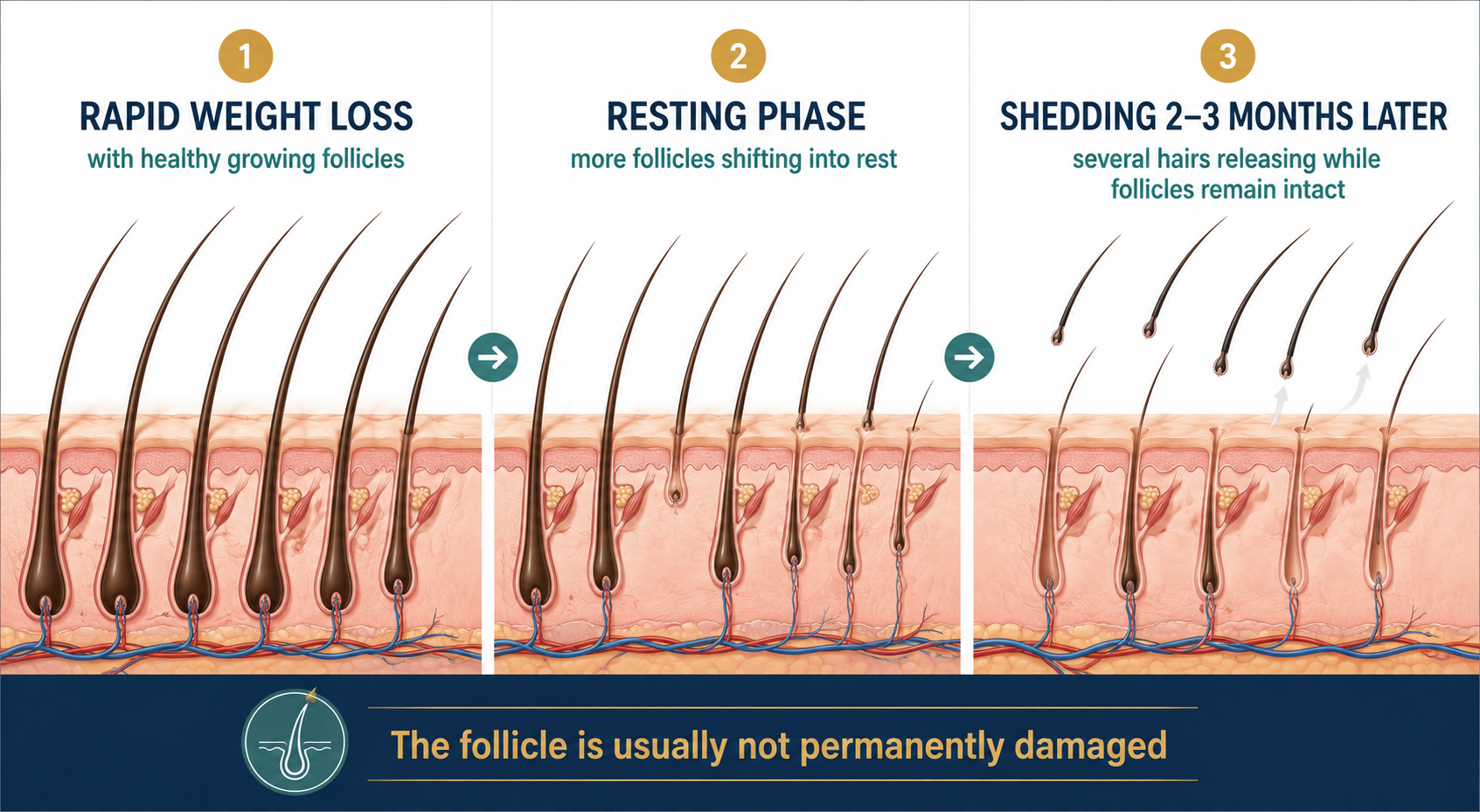
Hair grows in cyclical patterns- rapid growth phases give way to periods of rest and eventual shedding.
Massive or rapid weight loss- whether intentional or otherwise- illness or surgery can all prompt the body to transition more hairs than usual into the resting/shedding phase.
The resulting increased hair loss is called telogen effluvium and typically presents 2- 3 months after the inciting event.
So if someone begins Ozempic in January, limits their food intake and loses the weight rapidly in March, they might notice diffuse hair loss beginning in April.
This type of hair loss rarely presents with focal areas of balding, tight scalp sensations, rash, or scarring.
Instead, it often manifests as an increased amount of hair being noted in the pillowcase or comb, with less overall fullness to the hair on the scalp. The follicles themselves, however, are typically present and healthy- able to resume growth, if the inciting issue is resolved.
What do the newer studies show?
Wegovy (the higher dose version of Ozempic) has the same active ingredient but is dosed differently and indicated for different reasons.
In Wegovy’s trials, hair loss was reported by 3% of participants, compared to 1% of those on placebo.
A number of studies performed since then also show similar trends in electronic health record databases and adverse event reporting systems.
A study published in 2026, notes an increased likelihood of non-scarring hair loss in those using any of the various GLP-1 agonists, compared to those on other diabetes medications.
The increased relative risk was notable, if small in absolute terms- only several additional cases per 1,000 persons per year.
Further, these studies are confounded by the fact that those on GLP-1s are often losing weight intentionally and may experience nutritional restrictions as part of their treatment in addition to the medication itself.
Things like calorie restriction, slowed digestion, hormonal changes, and shifts in insulin regulation can all contribute to hair loss independent of medication.
So while there is a signal, it is challenging to sort out medication effects from underlying low-calorie intake effects.
At this point, we can say with confidence that there is an association; but causation still has not been proven.
Shedding is sometimes a sign of not enough of something- especially when it comes to what you’re not eating anymore.
Loss of appetite can be a powerful side effect of Ozempic.
Someone who previously ate three square meals might find themselves skipping breakfast or only allowing themselves small snacks throughout the day.
While the scale may be moving in the desired direction, protein and micronutrient intake could be inadequately low.
Hair is not an indispensable organ, and the body will prioritize other tissues in times of perceived scarcity.
Low iron stores, for example, can prompt telogen effluvium- especially in menstruating individuals.
Thyroid hormone abnormalities, vitamin deficiencies, diabetes, and hormonal changes associated with menopause or androgenic alopecia can also contribute to hair loss, independently of medication.
This means that a hasty conclusion that the medication is the culprit might actually lead us away from the real issue.
Will things necessarily improve?
In many cases, yes- but it depends on why the initial shedding occurred and if your nutritional and hormonal needs are being met.
As mentioned, rapid, significant weight loss can be a cause of telogen effluvium- but this type of hair loss typically resolves as the person’s weight stabilizes.
That is not to say that the hairs will simply start growing back- it typically takes months for the hairs to work their way out of the scalp, and then months again for new hair to grow in its place.
Purchasing a bottle of “hair vitamins” might not be the most effective option.
Supplements often contain therapeutic doses of specific micronutrients, that may help if you’re found to be deficient in any of them; but mega-dosing is unlikely to provide any additional benefit, and may even be harmful or interfere with lab tests.
It may be a good idea to see where you stand with a serum ferritin test, perhaps a CBC if you are experiencing fatigue or easy bruising, or thyroid function tests if you have any of the symptoms frequently seen with hypo/hyperthyroidism. The tests ordered, if any, should be individualized to the symptoms you are experiencing.
Should the Ozempic be stopped?
Not typically- but it depends on why you’re having hair loss and if stopping the medication is counteracted by another benefit.
Weight loss medications are often a cornerstone of management for obese or overweight individuals who have other health conditions.
For many patients, they provide real improvement to glucose regulation, cardiovascular risk, and even kidney function.
Stopping the medication cold turkey (without discussion with your provider) might lead to unwanted side-effects, increased risk of complications, or worsening of symptoms related to another condition.
Review your rate of weight loss, discuss any ongoing nausea, vomiting, or loss of appetite with your prescribing provider. Perhaps your dose is being increased too quickly, or you may need to allow your body time to adjust to a new dose or diet changes. Nutritional or pharmaceutical support may be an option, but should also be individualized.
Those taking other medications for diabetes should speak with their provider before making any dosing changes.
Focal loss of hair, redness or scaling of the scalp, painful scalp sensations or bald patches are not typical features of telogen effluvium and should be evaluated by a dermatologist.
So should continued or excessive hair loss that lasts longer than 6 months.
Hair loss is not uncommon, and typically not permanent. Notably, it does not appear to be terribly common with Ozempic, either.
The biggest tip-off that there is an issue may well not be the injection itself, but the rapid weight loss, changes to the meal schedule, and adjustment to a new body weight.