
A couple can get along well, share a bed every night, and still reach a point where sex quietly disappears.
At first, nobody says much. One person initiates less often. The other notices but waits. A few weeks become a few months, and what started as tiredness begins to feel personal.
“Are you no longer attracted to me?”
“Is something wrong with us?”
“Why is my sex drive so low?”
Sometimes there is a medical explanation. Testosterone may be low. Menopause may have made sex uncomfortable. A new antidepressant may have flattened desire so gradually that the connection was easy to miss.
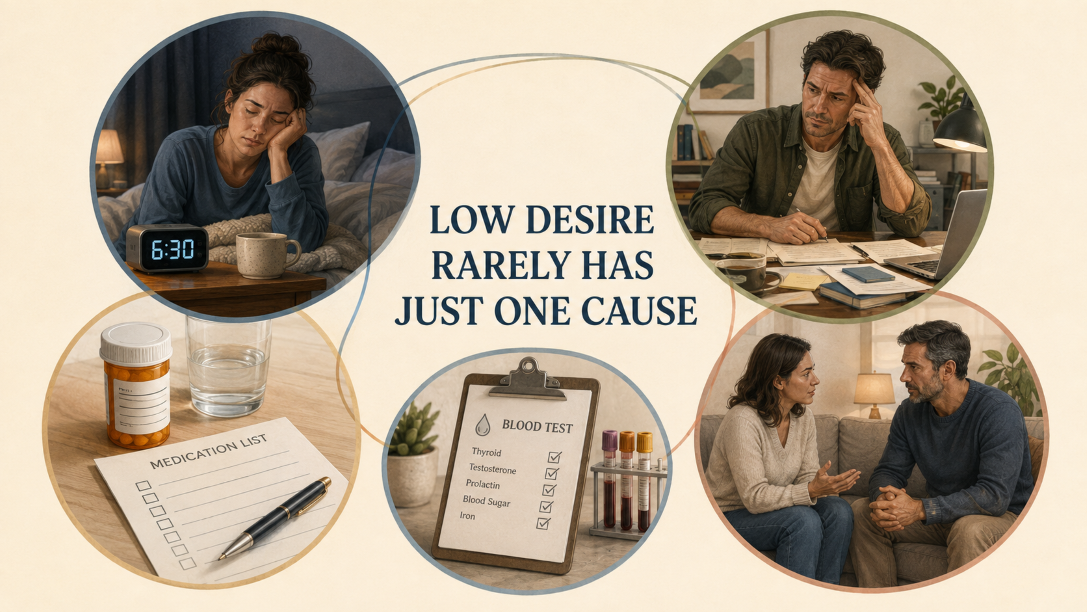
Just as often, several smaller things have piled up. Poor sleep. A demanding job. Young children. Unresolved arguments. Too much alcohol. Not enough privacy. Sex has begun to feel like another responsibility waiting at the end of an already full day.
Low libido is not one condition with one treatment. It is a change in sexual interest, and the reason behind that change matters far more than any supplement advertised as a “libido booster.”
What does low libido actually mean?
Libido is another word for sexual desire—the interest or motivation to engage in sexual activity.
There is no medically correct amount of desire. Some people think about sex every day. Others rarely do. A couple can have sex once a month and feel perfectly content, while another couple becomes unhappy when sex drops from three times a week to once.
The number alone does not tell you whether there is a problem.
Low libido usually means that sexual interest has become noticeably lower than it used to be, lower than someone wants it to be, or low enough to create distress in a relationship.
A person may notice that:
- Sexual thoughts and fantasies have become rare
- They no longer initiate sex
- A partner’s advances feel irritating or burdensome
- They have little interest in masturbation
- Sex sounds fine in theory but never feels worth beginning
- Physical affection is avoided because it might lead to sex
- They still enjoy sex once it starts but almost never feel spontaneous desire beforehand
That final situation is more common than many people realize.
Desire does not always arrive first. Some people experience responsive desire: interest appears after affectionate touch, kissing, conversation, or physical arousal has already begun. They may not spend the afternoon wanting sex, yet enjoy it once they feel relaxed and connected.
This does not mean anyone should agree to unwanted sex and hope desire eventually appears. It means that waiting for a sudden burst of spontaneous passion may not reflect how desire works for everyone, particularly in long relationships.
Is low libido the same as erectile dysfunction?
No. Desire and erections are related, but they are not the same thing.
A man can want sex and still struggle to get or maintain an erection. That is erectile dysfunction. Another man may have perfectly normal erections in the morning or during masturbation but feel little interest in having sex. That is closer to low libido.
Of course, the two can overlap.
A man who has lost an erection several times may begin avoiding sex because he expects it to happen again. From his partner’s perspective, he seems uninterested. In reality, he may be interested but anxious.
The reverse can happen too. A man with little desire may have fewer sexual situations in which an erection would normally develop. He then worries that his erections have stopped working, when the first change was actually a loss of interest.
Sildenafil and tadalafil can help erections in appropriate patients, but they do not manufacture sexual desire. They improve the physical response to stimulation. A man still needs some degree of arousal.
If erection firmness is the main concern, established erectile dysfunction treatments are more relevant than a general libido supplement. If there is no interest in sex at all, it makes sense to look beyond blood flow.
Why is my sex drive so low?
People naturally look for one explanation. Usually they look for a hormone.
“My testosterone must be low.”
“My estrogen is gone.”
“My thyroid is probably slow.”
Hormones can absolutely affect desire. But low libido rarely arrives with a name tag. Sleep, health, medication, mood, pain, body image, and the relationship itself can all be involved.
Consider a 42-year-old man who has stopped initiating sex. He has gained weight, sleeps about five hours a night, drinks most evenings, and started an antidepressant six months ago. He and his partner have also been arguing about money.
It would be convenient to identify one culprit. In real life, each part may be taking something away from desire.
Stress can leave very little room for sex
A person does not need to be clinically depressed to lose interest in sex. Ordinary stress can do it.
Work follows people home through email and notifications. Children wake during the night. Bills arrive. Parents become ill. By bedtime, the brain is still reviewing tomorrow’s problems.
Sex requires a certain amount of attention. When the mind remains occupied by deadlines, childcare, or money, desire may struggle to get through.
This often creates a misunderstanding between partners. The person with lower libido thinks, “I am exhausted.” Their partner hears, “I do not want you.”
Pressure then makes the problem worse. Every hug begins to feel like a possible request for sex. The lower-desire partner starts avoiding affection to avoid disappointing the other person. The higher-desire partner feels increasingly rejected.
Soon, they are no longer dealing only with tiredness. They are dealing with hurt feelings, anxiety, and a pattern in which neither person feels safe bringing up sex.
Sleep is not optional for a healthy sex drive
People often search for a supplement before looking at the time they go to bed.
A few nights of poor sleep will not permanently erase libido, but chronic sleep deprivation affects energy, mood, stress tolerance, and hormonal health. It also makes almost every pleasant activity feel like effort.
There is nothing mysterious about a parent of a six-month-old having less interest in sex. The same is true of someone working night shifts or lying awake with untreated sleep apnea.
Men with sleep apnea may experience fatigue, reduced morning erections, and sometimes lower testosterone. Women carrying most of the household and childcare load may reach the evening with no mental space left for intimacy, even if the relationship itself is loving.
If sex drive is lowest during the busiest and most exhausting periods of life, the body may not be broken. It may simply be tired.
Depression and anxiety can affect desire in different ways
Depression can make food, hobbies, friendships, and sex feel less rewarding. A person may still care deeply about their partner but feel emotionally flat.
Anxiety often works differently. Someone may want sex but find it difficult to stay mentally present. Their attention moves toward performance:
“Will I get an erection?”
“Will I reach orgasm?”
“Does my body look strange?”
“Is my partner enjoying this?”
Once sex becomes an examination, desire tends to leave the room.
Past sexual trauma or painful experiences can also affect interest. The body may respond to intimacy with tension even when the person consciously trusts their current partner. Pushing harder rarely solves this. Trauma-informed therapy and a slower return to comfortable touch are often more helpful.
Could medication be lowering your libido?
Yes—and this is easy to miss when the medication is otherwise working.
Selective serotonin reuptake inhibitors, or SSRIs, are well known for sexual side effects. These can include reduced desire, difficulty becoming aroused, delayed orgasm, or inability to orgasm. Common examples include sertraline, paroxetine, fluoxetine, and escitalopram.
The timing is not always obvious. Someone starts treatment during a period of depression, when libido is already low. Months later, their mood improves but sexual desire does not return. Is the remaining problem depression, the medication, or both?
Other medicines that may affect sexual interest or function include certain:
- Blood-pressure medications
- Antipsychotics
- Opioid pain medicines
- Anti-seizure medicines
- Hormonal treatments
- Prostate medications
- Cancer treatments
Hormonal contraception can affect desire in some women, although the experience varies widely. One woman notices a clear change after starting a particular method; another feels better because she no longer worries about pregnancy.
Do not stop an antidepressant or other prescription suddenly. Withdrawal symptoms and a return of the original condition may be much harder to manage than the sexual side effect. A prescriber may adjust the dose, change medications, or consider an alternative with fewer sexual effects.
Bupropion is sometimes considered when antidepressant-related sexual dysfunction is a concern, although it is not suitable for everyone. Faast Pharmacy’s antidepressant treatment information can help patients recognize the medicines involved before speaking with their prescriber.
Does low libido mean low testosterone in men?
Sometimes. Not always.
Low sexual desire is one of the more suggestive symptoms of testosterone deficiency, particularly when it appears alongside fewer spontaneous erections, reduced energy, loss of muscle, infertility, or testicular changes.
But tiredness and low libido are common symptoms with many possible causes. A man who is stressed, sleeping badly, depressed, or drinking heavily may assume his testosterone is low before a blood test has been performed.
Testing needs to be done properly. The Endocrine Society recommends diagnosing male hypogonadism only when a man has compatible symptoms and repeatedly low testosterone levels. That generally means at least two early-morning blood tests on different days.
Why repeat the test? Testosterone moves throughout the day and can fall temporarily during illness, severe calorie restriction, poor sleep, or excessive physical stress. One low afternoon result is not enough to diagnose a lifelong hormone disorder.
If testosterone is confirmed to be low, the next question is why. Obesity, sleep apnea, opioid use, testicular disease, and problems involving the pituitary gland can all play a role.
Testosterone treatment can improve desire in men who genuinely have hypogonadism. It is much less likely to transform the sex drive of a man whose hormone levels are already normal. Treatment can also reduce sperm production, which matters for anyone planning children.
Low libido in women is rarely just about one hormone
Women’s desire can change during pregnancy, after childbirth, while breastfeeding, around menopause, or after gynecological surgery. Hormones are part of that story, but they are rarely the whole story.
After a baby, for example, estrogen may be lower, particularly during breastfeeding. Vaginal dryness can make sex uncomfortable. Sleep is broken. The body feels unfamiliar. Privacy has disappeared. One partner may be touched all day by a baby and feel no desire for more physical contact by evening.
Calling that simply “low estrogen” misses most of what is happening.
Menopause can bring a similar mixture. Falling estrogen may contribute to vaginal dryness, burning, and discomfort. If sex repeatedly hurts, desire often fades for a very understandable reason: the brain stops looking forward to something associated with pain.
Lubricants and vaginal moisturizers may help. Some women benefit from local vaginal estrogen or other treatment for genitourinary symptoms of menopause. Treating discomfort may allow desire to return, although estrogen itself is not a universal libido medication.
Women looking for broader treatment information can review Faast Pharmacy’s women’s health resources before discussing symptoms with a gynecologist.
What is hypoactive sexual desire disorder?
A low sex drive is not automatically a disorder.
For some women, persistent low desire that causes significant distress may fit a condition historically called hypoactive sexual desire disorder, or HSDD. Modern diagnostic language may also refer to female sexual interest/arousal disorder.
The word “distress” matters. A woman who rarely thinks about sex but feels comfortable with that does not necessarily need treatment. A woman who has experienced a major loss of desire and feels upset, worried, or disconnected from her partner may want help.
Before using the diagnosis, clinicians consider whether the change is better explained by a medical condition, medication, relationship difficulty, depression, pain, or another factor.
Two FDA-approved prescription options are available for certain premenopausal women with acquired, generalized HSDD:
Flibanserin, sold as Addyi, is taken daily at bedtime. It affects brain signaling rather than genital blood flow. Possible side effects include dizziness, sleepiness, nausea, fatigue, low blood pressure, and fainting. Alcohol and medication interactions require careful attention.
Bremelanotide, sold as Vyleesi, is injected under the skin before anticipated sexual activity. Nausea is common, and it can temporarily increase blood pressure. It is not appropriate for every patient.
These are not female versions of Viagra, and neither is meant simply to make sex more intense. The expected benefit is modest, and the diagnosis needs to fit.
The FDA has also warned about unapproved sexual-enhancement products containing hidden flibanserin, sildenafil, or tadalafil. A product sold as a natural libido supplement may contain real prescription ingredients without listing them. That creates obvious problems with dosing and interactions.
Relationship problems sometimes show up as “low libido”
A person can love their partner and still stop wanting sex with them.
Resentment is not especially erotic. Neither is feeling criticized, ignored, pressured, or taken for granted.
Sometimes desire disappears after years of predictable sex that no longer feels pleasurable. The lower-desire partner has spent a long time participating without saying what they want. Eventually, avoiding sex becomes easier than having another disappointing encounter.
There may also be a desire mismatch rather than an illness. One partner wants sex twice a week; the other is comfortable with twice a month. Neither is medically abnormal, but the difference can create real tension.
The least helpful conversation usually begins in bed immediately after rejection.
A better conversation happens at a neutral time. Instead of “You never want me,” try something closer to: “I miss feeling close to you, and I want to understand how sex has been feeling for you lately.”
That question may uncover pain, embarrassment, boredom, fear of erectile failure, exhaustion, or a need for more affectionate contact that does not automatically lead to sex.
Couples therapy or sex therapy is not reserved for relationships on the edge of collapse. Sometimes a few honest conversations with guidance can stop years of guessing.
Can exercise increase sex drive?
It can help, although exercise is not a guaranteed aphrodisiac.
Regular activity may improve energy, circulation, mood, body confidence, sleep, and metabolic health. Those changes create better conditions for desire. Resistance training and aerobic exercise can also help address some health problems associated with sexual dysfunction.
There is a limit. Someone training intensely while eating too little and sleeping poorly may see the opposite effect. Men can experience temporarily lower testosterone, while women may develop menstrual disruption when energy availability becomes too low.
The useful dose of exercise leaves a person healthier and more energetic—not permanently exhausted.
Weight loss may help some people, especially when obesity, diabetes, or low testosterone linked to excess weight is part of the problem. But telling someone to lose weight without addressing shame, medication, pain, or the relationship is rarely enough.
Do libido supplements work?
Most make promises that are far ahead of the evidence.
Products containing maca, ginseng, fenugreek, tribulus, horny goat weed, or various proprietary blends are often sold for desire. A few ingredients have limited studies suggesting possible benefits in selected groups. The research is generally small, inconsistent, or conducted using extracts that are difficult to compare with retail products.
Supplements can also interact with medication. Some affect blood pressure, blood sugar, bleeding risk, or liver enzymes.
Sexual-enhancement products deserve particular caution because regulators repeatedly find hidden prescription ingredients in supposedly natural supplements. If a capsule acts remarkably like sildenafil, it may be because sildenafil—or a chemically related substance—is inside it.
An established online pharmacy should clearly identify what a product contains and require a prescription when one is medically necessary. Mystery blends are not a sensible shortcut for a symptom with so many possible causes.
What tests might a doctor order?
Not everyone with low libido needs a large hormone panel.
A useful appointment usually begins with conversation. When did the change begin? Was it sudden or gradual? Is desire low in every situation or only with a partner? Are erections, lubrication, orgasm, or pain also involved? What medications changed around the same time?
Depending on the answers, testing may include:
- Morning total testosterone in men
- Repeat testosterone if the first result is low
- Thyroid-stimulating hormone
- Prolactin
- Blood glucose or A1C
- A complete blood count when anemia is possible
- Other hormone tests based on symptoms and reproductive stage
A man with low desire, headaches, and vision changes may need a different evaluation from someone who became tired and uninterested after starting an opioid.
A woman with pain and vaginal dryness needs a different assessment from someone whose desire disappeared after beginning an SSRI.
There is no single “libido blood test.”
What can you do when your sex drive is low?
Start with what changed.
Look back several months. Did libido fall after a new medication, illness, pregnancy, stressful job, relationship conflict, or change in sleep? The timeline often gives more useful information than a random supplement.
Take pressure off affection. Couples sometimes stop touching because every touch has become a negotiation about sex. Bring back contact that does not require an outcome: sitting close, kissing, massage, or going to bed together without an agreement to have intercourse.
Make sex easier to enjoy. If it is painful, dry, rushed, or predictably unsatisfying, low desire is not surprising. Lubrication, more time for arousal, different forms of touch, and honest feedback can matter more than trying to force spontaneous enthusiasm.
Protect sleep where possible. This advice sounds almost insulting to new parents and shift workers, but chronic exhaustion cannot be out-supplemented.
Review medication with a professional. Do not quietly reduce or stop treatment. Bring up sexual side effects directly; clinicians cannot help with a problem they do not know exists.
Address the health basics without expecting perfection. Exercise, smoking cessation, moderate alcohol use, management of diabetes and blood pressure, and treatment of sleep apnea may all improve the environment in which desire operates.
When should you see a doctor?
Make an appointment when low libido appeared suddenly, has persisted for several months, causes distress, or is affecting your relationship.
Earlier evaluation makes sense when it occurs with:
- Persistent erectile dysfunction
- Loss of morning erections
- Pain during sex
- Vaginal bleeding or severe dryness
- Testicular pain or shrinkage
- Infertility
- Menstrual changes
- Breast discharge
- Headaches or changes in vision
- Severe fatigue
- Depression or loss of interest in most activities
- Symptoms beginning after a new medication
A doctor does not need to decide whether your sex drive is “low enough.” If the change bothers you, that is enough reason to ask about it.
Low desire does not always mean something is broken
Sex drive changes. It responds to the body, but also to the life happening around the body.
A person may need hormone testing. They may need a medication adjustment. They may need treatment for painful sex, depression, erectile dysfunction, thyroid disease, or sleep apnea.
Or they may need a weekend without work messages and children knocking on the bedroom door.
The difficult part is resisting the urge to reduce every case to testosterone, attraction, or relationship failure. Low libido is often less of a single diagnosis and more of a signal. Something has changed, and desire is where that change became visible.
Finding the reason usually works better than chasing a product that promises to make everyone want sex on command.