The first sign is often not a bald spot. It is a shower drain that seems to collect more hair than usual. A thicker clump in the brush. A ponytail that suddenly feels a little smaller.
For someone taking Ozempic, Wegovy, Mounjaro, or Zepbound, the medication quickly becomes the prime suspect.
Hair loss has followed GLP-1 medications through social media for several years, but until recently, the evidence was mostly anecdotal. Patients described shedding in Facebook groups and TikTok videos. Doctors reported isolated cases. The FDA collected adverse-event reports, but those reports could not show whether the medication itself was responsible.
Now larger studies are finding a signal. People using GLP-1–based medications appear to receive hair-loss diagnoses slightly more often than people using certain other diabetes drugs. Semaglutide and tirzepatide have attracted the most attention.
That sounds alarming, particularly when translated into headlines about a “68% higher risk.” Yet the actual chance of developing hair loss remained low in the latest research. Most reported cases were also non-scarring, which means the follicles were not permanently destroyed and regrowth may be possible.
So yes, hair shedding can occur while taking Ozempic or Mounjaro. What remains uncertain is whether the medication attacks the hair follicle directly—or whether the body is reacting to rapid weight loss, reduced food intake, nutritional deficiencies, hormonal shifts, and the physical stress of a major metabolic change.
For many patients, the answer is probably a mixture of factors.
What did the new study find?
A 2026 study examined health records from approximately 50,000 adults with type 2 diabetes. Researchers compared people using GLP-1 medications with patients taking SGLT2 inhibitors or DPP-4 inhibitors, two other groups of diabetes drugs.
Hair-loss diagnoses were more common among GLP-1 users. The relative risk was approximately 37% higher than with SGLT2 inhibitors and 68% higher than with DPP-4 inhibitors.
Those percentages need context.
Relative risk describes the difference between groups. It does not tell you how frequently the event occurred. In absolute terms, the studies suggested roughly 3 to 9 additional or total cases per 1,000 people per year, depending on the analysis and comparison group. Hair loss was still uncommon.
A person reading “68% higher risk” might imagine that more than half of Ozempic users lose their hair. That is not what the study found.
The research was also observational. It identified an association but could not prove causation. The groups may have differed in weight loss, diabetes severity, nutritional status, thyroid health, age, sex, or other factors that influence hair.
Even with those limitations, the finding deserves attention because it agrees with other evidence. A 2026 systematic review reported that semaglutide and tirzepatide showed the most consistent hair-loss signals among GLP-1–based medications. Another dermatology review concluded that the association appears plausible but has not been established through prospective trials designed specifically to measure hair loss.
The most accurate summary is not “Ozempic makes your hair fall out.” It is that hair loss appears to be an uncommon but credible problem during GLP-1 treatment, particularly when substantial weight loss occurs.
Why rapid weight loss can trigger shedding
Hair is sensitive to disruption.
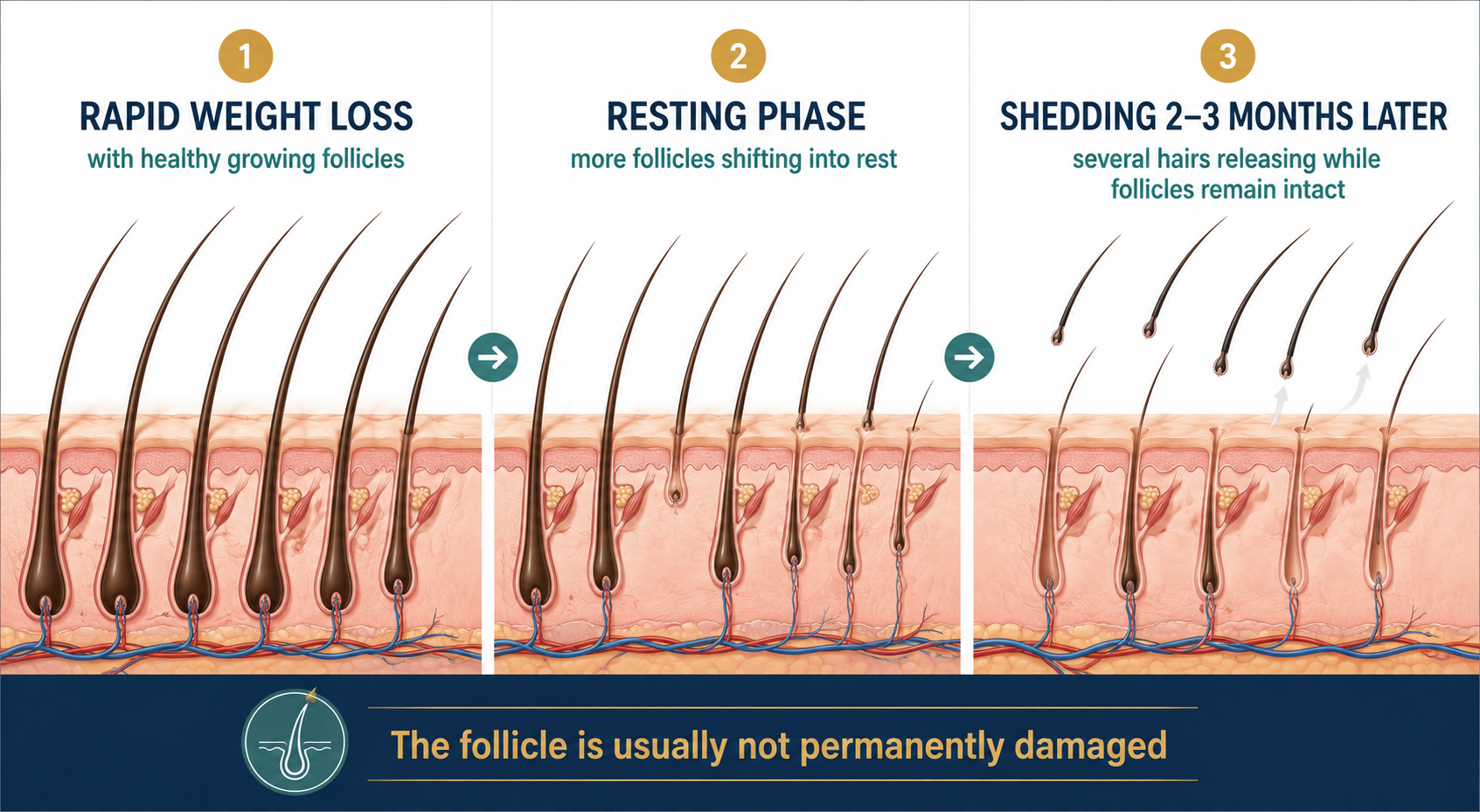
At any given time, most scalp hairs are actively growing. A smaller percentage are resting or preparing to shed. Illness, surgery, childbirth, severe emotional stress, nutritional deficiency, and rapid weight loss can push an unusually large number of follicles into the resting phase.

Doctors call this type of temporary shedding telogen effluvium.
What often puzzles patients is the delay. The hair does not usually start falling out while the weight is dropping fastest. Instead, the follicles enter a resting phase, and the increased shedding may not become noticeable until two or three months later.
A person might start semaglutide in January, lose a considerable amount of weight during February and March, and only begin finding extra hair in the shower in April. By then, the connection is easy to miss.
The shedding is usually spread across the entire scalp. Hair may feel thinner, and noticeably more strands may collect in the brush or shower drain, but there is rarely one distinct bald area. The scalp itself generally looks healthy because the follicles have not been scarred or destroyed. In most cases, they can begin growing hair again once the body adjusts.
This response is not exclusive to Ozempic. Doctors have seen the same pattern after bariatric surgery, severe illness, and restrictive diets. Any rapid physical change can disrupt the normal hair-growth cycle.
GLP-1 medications can help people lose a substantial amount of weight in a relatively short time. That weight loss may improve blood sugar, blood pressure, sleep apnea, and cardiovascular health. To the hair follicles, however, such a fast change can still register as physical stress.
Clinical trials support that possibility. In semaglutide weight-management studies, hair loss was reported more often among people who lost at least 20% of their starting weight. Tirzepatide trials also recorded more cases of hair loss in treated participants than in those receiving a placebo.
These findings do not prove that rapid weight loss is responsible for every case. They do suggest that the amount and speed of weight lost may matter at least as much as the medication itself.
The medication may not be the only factor
Not everyone eats the same way while taking Ozempic. One patient may continue having balanced meals and lose weight at a steady pace. Another may feel full after a few bites or become nauseated whenever they try to eat a proper meal.
Both may be pleased with the number on the scale, but their bodies are not necessarily getting the same support.
Hair growth uses energy and nutrients. When someone is eating much less than usual, the body has to make choices. The heart, brain, and other essential organs come first. Growing hair is much lower on the priority list.
Protein is one of the first things I would ask about. Before Ozempic, a patient might have eaten eggs in the morning, meat or beans at lunch, and fish or chicken in the evening. After starting treatment, breakfast disappears, lunch becomes a piece of toast, and dinner is a few spoonfuls of soup because anything more feels uncomfortable.
That may be enough to lose weight, but not always enough to protect muscle and support normal hair growth. If it continues for weeks or months, shedding becomes more likely.
Iron is worth checking too, especially in women with heavy periods or anyone who had low iron stores before starting the medication. Low vitamin B12, folate, zinc, or vitamin D can sometimes contribute as well. That does not mean everyone with hair loss should immediately buy five different supplements. Taking large doses without knowing what is actually low can be unhelpful and, in some cases, harmful.
The cause may have nothing to do with nutrition. Thyroid problems can produce the same kind of all-over thinning. Diabetes may affect circulation and create additional stress on the hair cycle. Recent illness, surgery, or a period of intense emotional stress may also be part of the story.
And sometimes Ozempic gets blamed for hair loss that had already started. Male- or female-pattern thinning can progress slowly for years without attracting much attention. A period of sudden shedding may simply make that existing loss easier to see.
This is why it is worth looking beyond the injection. If every loose hair is automatically blamed on Ozempic, a correctable problem—such as iron deficiency, thyroid disease, or inadequate protein intake—may be missed.
Does Mounjaro cause more hair loss than Ozempic?
Mounjaro and Zepbound contain tirzepatide, and some studies have reported hair loss slightly more often with tirzepatide than with semaglutide.
In one analysis, around 4.2% of people using tirzepatide reported hair loss, compared with about 3.3% of those using semaglutide. The difference is not enormous, and those numbers do not prove that Mounjaro is harder on the hair. The patients were not necessarily starting from the same weight, using equivalent doses, or losing weight at the same speed.
That last point matters. Tirzepatide often produces more weight loss on average than semaglutide. If the body reacts to rapid weight change by shifting more hairs into the resting phase, it would make sense to see more shedding among people who lose the most weight. The medication may not be directly damaging the follicle at all.
There are plenty of other variables. Someone taking a higher dose for a longer period may have a different experience from a person losing weight slowly on a lower dose. Diet, protein intake, iron levels, diabetes control, age, sex, and a family history of thinning hair can all influence what happens.
For that reason, I would not choose between semaglutide and tirzepatide based on a small difference in reported hair loss. Whether the medication is appropriate for the patient, how much benefit it is likely to provide, its other side effects, cost, and medical history are much more useful considerations.
If shedding does occur, the better question is not simply, “Which drug is worse?” It is whether the weight is coming off too quickly, the patient is managing to eat properly, or another cause of hair loss has been overlooked.
Is Ozempic hair loss permanent?
When the problem is telogen effluvium, it is usually temporary.
Once weight stabilizes and the triggering stress has passed, the follicles can gradually return to active growth. Shedding may continue for several months because the hair cycle moves slowly. Visible density takes even longer to recover.
Many people expect immediate regrowth as soon as they begin eating better or reduce the medication dose. Hair does not work on that timetable. New growth may appear as short hairs along the hairline or part, but restoring noticeable length can take six to twelve months.
Permanent thinning is more likely when another condition is involved. Telogen effluvium may reveal androgenetic alopecia that was already developing. A patient’s shedding may improve, yet the underlying pattern hair loss can continue.
Scarring alopecia is different. It involves inflammation that damages follicles and can lead to permanent loss. Pain, burning, redness, scaling, pustules, or smooth shiny patches require medical attention and should not be dismissed as a routine weight-loss effect.
Sudden round patches also suggest another diagnosis, such as alopecia areata.
Should you stop Ozempic if your hair starts falling out?
Not without speaking to the prescriber.
Stopping diabetes treatment abruptly can worsen blood glucose control. Discontinuing a weight-management medication may increase appetite and lead to rapid weight regain. Neither outcome is automatically better for overall health—or for the hair.
The sensible response depends on severity.
Mild shedding with otherwise successful treatment may be managed by reviewing weight-loss speed, protein intake, calories, and possible deficiencies. If nausea makes it difficult to eat, the dose-escalation schedule may need adjustment.
The prescriber may decide to hold the current dose longer rather than increasing it. In more severe cases, reducing the dose or changing treatment may be reasonable. That decision should consider the medication’s benefits as well as the hair loss.
Patients should also be careful about buying additional medications or supplements from questionable websites. A licensed online pharmacy should provide clear product information and require appropriate medical oversight for prescription treatment. Hair loss is not a reason to begin stacking unregulated “growth” products with a GLP-1 drug.
What tests might be useful?
There is no single blood test for Ozempic-related hair loss.
A clinician may begin with the timeline. When did treatment start? How much weight was lost, and how quickly? Did shedding begin two or three months after the greatest change? Has food intake fallen dramatically?
Depending on the patient, testing may include a complete blood count, ferritin and iron studies, thyroid-stimulating hormone, vitamin B12, folate, vitamin D, or zinc. Not everyone needs the entire list.
Ferritin deserves careful interpretation. Low iron stores can contribute to shedding, but the “ideal” ferritin level for hair growth remains debated. Iron supplements should not be taken casually because excess iron can be harmful.
Biotin testing is rarely the answer. True biotin deficiency is uncommon, and high-dose biotin supplements can interfere with laboratory tests, including thyroid and cardiac tests.
The medical history may be more revealing than an enormous supplement panel. Heavy menstrual bleeding, recent illness, surgery, childbirth, restrictive dieting, thyroid symptoms, and family history of pattern hair loss all offer useful clues.
Can biotin, collagen, or hair vitamins prevent the problem?
Probably not unless they correct a real deficiency.
Biotin has become the default answer to almost every hair complaint, despite limited evidence that it improves growth in people who are not deficient. Most patients already obtain enough through food.
Collagen supplements provide amino acids, but they are not a replacement for adequate dietary protein. A powder marketed with beautiful hair photographs cannot compensate for consistently inadequate meals.
“Hair vitamins” often combine biotin, zinc, selenium, iron, and several other nutrients. More is not necessarily better. Excess selenium can itself cause hair loss. Too much vitamin A can do the same. High zinc intake may eventually produce copper deficiency.
A better approach is less glamorous: eat enough protein, avoid extreme calorie restriction, investigate deficiencies when the history suggests them, and use targeted treatment rather than a handful of overlapping supplements.
A dietitian can be especially useful for patients who are losing weight quickly or struggling with appetite. The goal is not to stop medically beneficial weight loss. It is to lose weight without depriving the body of the materials it needs to maintain muscle, blood, bone, and hair.
What can help while the hair recovers?
Gentle hair care will not end telogen effluvium, but it can reduce unnecessary breakage. Avoid repeatedly pulling the hair into tight styles. Limit aggressive bleaching, high heat, and chemical treatments during heavy shedding. Use conditioner and detangle carefully.
Regular washing does not cause the loss. Shampoo simply releases hairs that have already completed their cycle. Washing less often can make each shower look more dramatic because several days of shed hair appear at once.
Topical minoxidil may be helpful when pattern hair loss is present and is sometimes considered for prolonged shedding. It is not appropriate for everyone, and early use can temporarily increase shedding. A dermatologist can determine whether it fits the diagnosis.
Patience matters more than most products. The follicle needs time to re-enter growth, and the new hair needs time to become visible.
When should you see a dermatologist?
I would not send every patient to a dermatologist because they found more hair than usual in the shower. Temporary shedding often settles once weight loss slows and eating becomes more consistent.
There are times when it should not simply be watched, though. Make an appointment if the shedding is still heavy after six months, your part is becoming wider, or you can clearly see that the hair has lost density.
Patchy hair loss is a different situation. So is a scalp that burns, hurts, itches, or develops redness and scaling. Those features are not typical of straightforward telogen effluvium, so I would have them checked earlier.
A dermatologist can examine the scalp under magnification and usually get a much better idea of what is happening. Sometimes the patient is shedding hair from the root. Sometimes the strands are breaking. In other cases, the pattern points to alopecia areata, inflammation, or ordinary hereditary thinning that happened to become noticeable after starting Ozempic.
The rest of the medical picture matters too. Irregular periods, new facial hair, and acne in a woman may suggest a hormonal issue such as polycystic ovary syndrome. A man who is gradually losing hair at the temples and crown may simply be developing male-pattern hair loss. The timing can make the medication look responsible even when the process had already begun.
Call the GLP-1 prescriber sooner if the shedding comes with ongoing vomiting, dizziness, dehydration, marked weakness, or days when you can barely eat. At that point, hair is not the main concern. The dose may need reviewing because the body is struggling to get enough food and fluid.
Ozempic may be part of the explanation, but it should not end the investigation. Hair loss can be the first visible sign that the weight is coming off too quickly, nutrition has slipped, or another health problem needs attention.
What the evidence means for patients
The latest research makes two things clear at the same time.
First, hair loss during GLP-1 treatment is not imaginary. Larger studies now support a small association, and semaglutide and tirzepatide carry the strongest signals.
Second, most users will not develop clinically diagnosed hair loss. The absolute risk remains low, and the most likely form—telogen effluvium—is generally non-scarring and reversible.
The medication may play an indirect role by producing rapid weight loss or making adequate nutrition difficult. A direct effect on hair biology remains possible, but researchers have not proved it.
Patients should not be frightened away from effective diabetes or obesity treatment by an exaggerated headline. Nor should they be told that noticeable shedding is “just cosmetic” and ignored.
Hair loss deserves a calm review of timing, weight-loss speed, diet, blood tests when appropriate, and other possible diagnoses. Sometimes the solution is nutritional support and patience. Sometimes the medication plan needs adjusting. Occasionally, the shedding reveals a completely separate condition.
What matters is identifying which situation you are dealing with—before abandoning a useful treatment or buying a cabinet full of supplements.